Memory stocks crushed GPU makers in 2026 while Palantir fell 36%. Here's the real data behind the AI stock rally and rotation.

Best AI Performing Stocks in 2026: Real Market Data, Winners, and What's Driving the Rally
The biggest AI stock winners of 2026 are not the names most investors expected. Memory chipmakers Micron and Sandisk have outpaced the GPU giants by a wide margin, while AI software bellwether Palantir has fallen roughly 36% year to date. The rally is real, but it is rotating, not uniform.
What Has Actually Won in 2026
If you built a 2026 AI portfolio based on 2023-2025 headlines, you likely missed the year's biggest move. Memory and storage stocks, not GPU makers, have delivered the largest gains.
Sandisk has climbed roughly 493% year to date through mid-May, and Micron Technology gained about 154% over the same stretch, with its one-year return reaching as high as 703% by June. Both companies make the DRAM, NAND flash, and high-bandwidth memory (HBM) that AI data centers need to feed GPUs, and acute memory shortages through 2026 have pushed pricing and revenue sharply higher for both.
| Label | % YTD return |
|---|---|
| Sandisk | 493 |
| Micron | 154 |
| Intel | 169 |
| AMD | 118 |
| Nvidia | 29 |
| Palantir | -3 |
The semiconductor sector overall remains up sharply for the year. The Philadelphia Semiconductor Index (SOXX) was still up roughly 73% year to date even after a sharp early-June pullback, illustrating how strong the underlying 2026 rally has been despite a rough few weeks.
The Memory Shortage Is the Real 2026 Story
The reason memory stocks lead the pack is structural, not speculative. Spending on memory chips is projected to jump from $216 billion in 2025 to $633 billion in 2026, driven almost entirely by AI data center demand for DRAM, NAND, and HBM. Micron's DRAM business alone accounted for 79% of its revenue last quarter, and its fiscal Q2 2026 earnings jumped nearly eightfold year over year as a result.
Sandisk's results moved in the same direction. Revenue rose 251% year over year in its most recent quarter, with the company swinging from a loss to adjusted earnings of $23.41 per share, and customers are now signing multiyear supply contracts. One set of agreements alone, signed in a single quarter, was worth roughly $42 billion.
The shortage has spread beyond data-center-grade memory. Research firm IDC has warned that the global smartphone market faces its steepest year-on-year volume decline on record in 2026, down roughly 13%, as memory makers redirect supply toward higher-margin AI data center customers. The same dynamic pushing memory stocks higher is now squeezing consumer electronics supply chains.
The GPU Giants Are Still Winning, Just Less Dramatically
Nvidia and Broadcom remain the anchors of the AI infrastructure trade, but 2026 has been a more turbulent year for both than the headline AI narrative suggests. Nvidia briefly touched a market capitalization near $3.5 trillion earlier in the year before a sharp early-June selloff. Broadcom delivered record revenue, record operating profit, and record free cash flow in its fiscal Q2 2026 report, with AI chip revenue surging 143% year over year to $10.8 billion, yet still lost nearly $300 billion in market value in a single session because its Q3 AI revenue guidance of $16 billion came in below the roughly $17.2 billion analysts expected.
That reaction triggered the worst single-day chip selloff since March 2020. The Philadelphia Semiconductor Index dropped 10% on June 5, erasing approximately $1.4 trillion in sector value in one session, with Nvidia, AMD, Intel, and Marvell all caught in the downdraft alongside Broadcom.
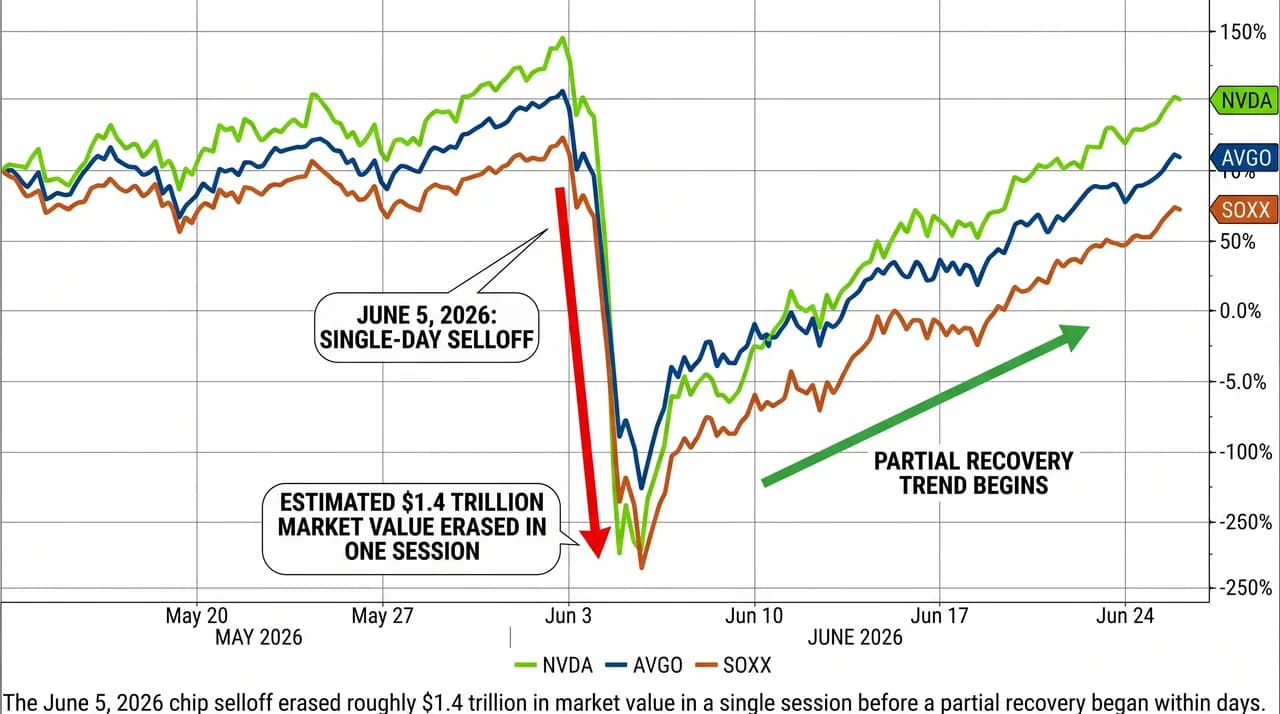
The selloff was driven by a combination of factors rather than any single cause: a stronger-than-expected May jobs report that revived fears the Federal Reserve could hold rates higher for longer, Broadcom's cautious AI guidance being read as a signal of slowing AI infrastructure spending broadly, and the deepening memory shortage squeezing related chipmakers. Within days, many of the affected stocks had recovered a meaningful portion of their losses, underscoring how quickly sentiment swings in this sector on guidance and macro headlines rather than on underlying demand.
Palantir's Reversal Is the Year's Biggest Surprise
No 2026 AI stock story has diverged more from its own recent past than Palantir's. After rising roughly 2,640% from 2023 through late 2025, far outpacing Nvidia's already extraordinary run over the same period, Palantir has fallen approximately 36% year to date in 2026 and was sitting just above its 52-week low in late June.
The drawdown is almost entirely a valuation story rather than a business story. Palantir's underlying fundamentals have stayed strong: Q1 2026 revenue reached $1.63 billion, beating estimates, and the company raised its full-year 2026 revenue guidance to roughly $7.65 billion, implying about 71% year-over-year growth. Despite that, the stock trades at over 120 times trailing earnings, leaving little room for any disappointment, and a widely shared bearish note from investor Michael Burry calling the stock a "narrative-driven" trade contributed to the sentiment shift in June.
What's Actually Driving the Broader AI Rally
Three forces are doing most of the work behind 2026's AI stock moves, and they explain why performance has diverged so sharply across the sector.
Hyperscaler capital spending remains enormous. Major cloud providers have committed roughly $750 billion in capital expenditure for 2026, the bulk of it aimed at AI infrastructure, data centers, and chip purchasing. That spending is the demand engine behind every chip and memory name on this list, and it has not meaningfully slowed even after the June selloff.
The memory shortage is reshaping winners within the sector. Because HBM production competes directly with conventional DRAM for the same wafer capacity, memory makers are seeing both higher prices and higher volumes simultaneously, a combination that shows up directly in earnings. That dynamic is unique to 2026 and explains why memory stocks have outperformed even the GPU makers that triggered the original AI rally.
Interest rate sensitivity has become a bigger swing factor than AI demand itself. The June selloff was triggered less by any change in AI spending plans and more by a stronger-than-expected jobs report that raised the odds of higher-for-longer interest rates, which compresses the valuation multiple investors are willing to pay for future earnings. Several analysts have noted that historically, Nvidia corrections driven by rate repricing rather than demand concerns have recovered within six to twelve months as subsequent earnings confirmed order books remained intact.
What This Means for How You Think About AI Exposure
The 2026 data points to a clear lesson: AI stock performance has become layer-specific rather than uniform across the sector. Owning only the most familiar names, chips and hyperscalers, would have meant missing the year's single biggest move in memory, and would have left a portfolio fully exposed to Palantir's valuation-driven reversal.
A more durable approach to AI exposure spreads risk across the distinct layers of the buildout: chipmakers and memory suppliers that sell the physical infrastructure, the hyperscaler platforms that rent out AI compute, and the software layer that turns models into products. Each layer carries a different risk profile and reacts differently to the same headline, which is exactly what 2026 has demonstrated.
The Bottom Line
2026 has rewarded investors who looked past the obvious AI names. Memory makers Micron and Sandisk delivered the sector's standout returns on the back of a genuine supply shortage, Nvidia and Broadcom remain structurally dominant but have proven more volatile around guidance than their fundamentals alone would suggest, and Palantir's sharp pullback shows that even genuinely strong AI revenue growth cannot fully insulate a stock from valuation risk. The AI buildout itself looks intact. Which companies capture the value from it keeps shifting, and 2026 has been the clearest demonstration yet of why that distinction matters.
This article is for informational purposes only and does not constitute investment advice. All investments involve risk, including the potential loss of principal, and past performance does not guarantee future results.
At Kovazu, we track the engineering and infrastructure forces actually driving AI markets, from inference cost structures to the memory and storage trends reshaping the hardware layer. If you want infrastructure built with that same understanding of where AI economics are headed, let's talk.
Written by
Emily CarterSenior Content Strategist & Market Trends Writer
Emily Carter writes about business, branding, SEO, and market trends with a focus on making complex topics easy to understand. She enjoys uncovering the strategies behind successful companies, emerging industries, and shifting consumer behavior. When she's not researching the latest market movements, Emily is exploring digital marketing trends, content strategy, and the evolving relationship between technology and business. Her goal is to create content that's insightful, practical, and worth bookmarking.