AI infrastructure spending is projected to reach $725 billion in 2026. Discover where hyperscaler investments are flowing from Nvidia and TSMC to memory, power, and data centers, and why these sectors are driving the AI economy.
The 2026 AI Capex Supercycle: Where the Real Money Is Being Made in the Stock Market
Four companies are spending roughly $725 billion this year building the infrastructure for AI, and almost none of it is going to the AI labs everyone talks about. It is going to chipmakers, memory manufacturers, power companies, and data center operators. Understanding where that money actually lands is the difference between watching the AI story from the sidelines and understanding where the real economics sit.
The Number That Changes Every Quarter, Upward
Microsoft, Amazon, Alphabet, and Meta are projected to spend around $725 billion combined on capital expenditure in 2026, up 77% from roughly $410 billion in 2025. Amazon leads at approximately $200 billion, Alphabet is guiding to $175 to $185 billion, Meta raised its full-year target to as much as $145 billion citing rising memory chip prices, and Microsoft is tracking above $120 billion, with some estimates closer to $190 billion once fiscal-year accounting is included.
Add Oracle's roughly $50 billion commitment and the five largest infrastructure spenders push toward $700 to $900 billion for the year. Goldman Sachs now projects combined hyperscaler capex from 2025 through 2030 will reach $5.3 trillion, and analysts are already forecasting spending will top $1 trillion annually by 2027.
This is not a marketing budget or a research grant. It is steel, silicon, concrete, and electricity, and it explains almost everything about which stocks have moved in 2026.
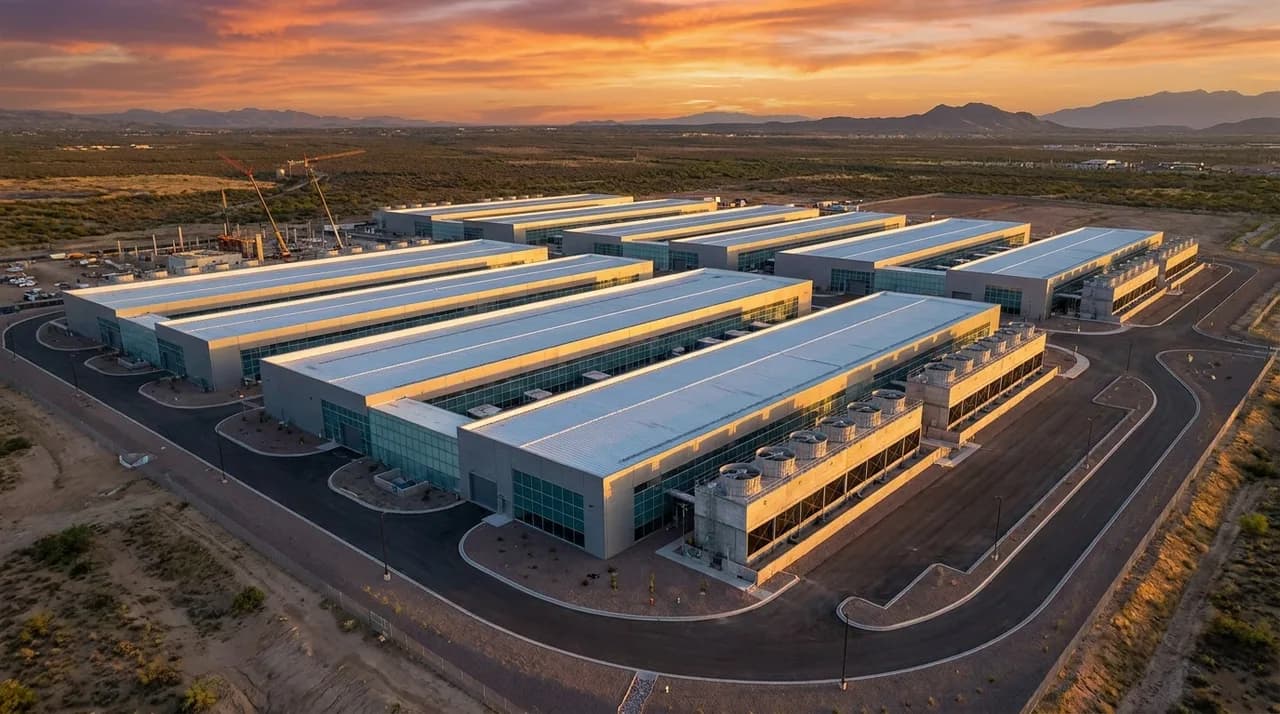
Why They Are All Spending at Once
The simplest explanation is also the correct one. Each company fears being structurally short on compute more than it fears overspending. Microsoft has confirmed it remains capacity-constrained, turning away Azure AI revenue it cannot currently serve, with a commercial backlog that has nearly doubled to $627 billion. Google Cloud's backlog jumped past $460 billion. Amazon's Bedrock platform processed three times more API calls in the first quarter of 2026 than it did in all of 2025 combined.
When four companies each believe the worst outcome is arriving late to serve demand that is already there, they build simultaneously rather than sequentially. That is the AI capex supercycle in one sentence: not proof that the returns are certain, but proof that none of the four can afford to be the one that under-built.
Layer One: The Chips, Where Nvidia Still Wins Big
The first dollar of any AI infrastructure budget goes to silicon, and Nvidia remains the largest single beneficiary. The company's fiscal 2027 first-quarter revenue rose 85% year over year to a record $81.6 billion, and Nvidia is projecting continued growth toward roughly $91 billion for the following quarter. That growth is underpinned by a reported $1 trillion combined sales forecast for its Blackwell and Vera Rubin chip generations across 2026 and 2027.
But the supporting cast is where the more interesting opportunities sit. Broadcom has built a distinct and rapidly growing business designing custom AI accelerators, known as XPUs, for hyperscalers who want silicon tailored to their own workloads rather than standardized GPUs. Broadcom's AI semiconductor revenue reached $8.4 billion in a single quarter, up 106% year over year, as Google, Meta, and other custom-silicon customers scale their own chip programs. Google's TPUs, Amazon's Trainium and Inferentia chips, and Microsoft's Maia processors are all part of this same trend: hyperscalers hedging their Nvidia dependence while still buying enormous volumes of Nvidia GPUs for training.
Layer Two: The Equipment Nobody Talks About
Behind the chip companies sits a layer of equipment makers that the AI narrative rarely mentions, and this is arguably where the least competitive, most durable economics in the entire supercycle live.
ASML is the only company in the world that manufactures the EUV and High-NA EUV lithography machines required to produce leading-edge chips. Every advanced logic chip and every high-bandwidth memory die shipping in 2026, regardless of whether it ends up in an Nvidia, AMD, or Broadcom product, passes through an ASML machine at some point in its production. There is no second source and no workaround. ASML posted a 53% gross margin in its most recent quarter and raised its full-year revenue outlook to as much as €40 billion.
Lam Research and KLA sit one level down, dominating the etch, deposition, and process-control steps required to build the vertical 3D memory structures that high-bandwidth memory depends on. As HBM demand accelerates across every AI chipmaker's roadmap, these equipment suppliers benefit regardless of which chip design ultimately wins.

Layer Three: Memory Is the Bottleneck Making Headlines
Memory has become one of the tightest and most consequential constraints in the entire supercycle. There are only three major global memory manufacturers, Micron, SK Hynix, and Samsung, and demand for high-bandwidth memory used in AI accelerators has pulled production capacity away from conventional DRAM and NAND markets. That scarcity is directly responsible for Meta and Microsoft both citing rising memory component costs as a factor in their raised capex guidance this year.
For memory makers, this has been transformative. Rather than competing purely on volume in a commodity market, HBM commands premium margins, and the companies that can reliably supply it at scale have seen a structural repricing of their entire business.
Layer Four: Power Is the New Physical Limit
Chips and equipment can be manufactured faster than most people expect. Electricity cannot. Power has emerged as the binding physical constraint on how quickly this entire buildout can actually happen, and that has turned utilities and power infrastructure into an unlikely centerpiece of the AI investment story.
Microsoft's projected electricity demand for AI data centers is expected to surge over 600% by 2030. Google spent close to $4.75 billion acquiring a power company outright to secure supply directly. Companies that manufacture gas turbines for grid-scale power generation have seen backlogs balloon far beyond what current production can fulfill, in some cases with equipment order backlogs many multiples larger than a full year's current revenue.
Data center landlords are capturing their own share of this value. Equinix and Digital Realty, the two largest colocation and hyperscale data center REITs, have seen core market vacancy fall below 3% with lease rates stepping up by double digits on renewal, as hyperscalers increasingly lease capacity from operators who can move faster on permitting and power access than building from scratch themselves.
The Risk Nobody Is Pricing In Yet
None of the four hyperscalers have yet demonstrated a clearly positive return on their AI infrastructure investment at the scale they are now deploying it. That does not mean the spending is misguided, but it does mean the entire capex stack is a correlated bet. When four of the largest companies in the world commit to the same infrastructure thesis simultaneously, they also share the same downside if enterprise AI adoption or monetization slows before the buildout is paid off.
Markets have already shown early sensitivity to this. Meta's stock dropped over 9% in a single session after raising its capex guidance, the first real investor pushback against the spending trajectory. Free cash flow across the group is compressing meaningfully, with Amazon's own free cash flow projected to turn negative this year as a direct result of the spending pace.
What This Means for How You Think About AI Exposure
The clearest lesson from 2026 is that the AI capex supercycle rewards the picks-and-shovels layer more predictably than it rewards the AI products built on top of it. Chipmakers, foundries, lithography equipment makers, memory manufacturers, power infrastructure, and data center landlords are all capturing real, growing revenue tied directly to committed spending that is already contracted. The AI labs and consumer-facing products sitting on top of that infrastructure face a much less certain path to matching that spending with revenue.
That does not make the infrastructure layer risk-free. Concentration, correlated downside, and the possibility that enterprise AI adoption disappoints relative to the capex already committed are all real risks sitting underneath the current numbers. But understanding the layers, chips, equipment, memory, and power, gives a much clearer picture of where the money in this cycle is actually landing than following any single headline stock.
How Kovazu Thinks About This
At Kovazu, we build the AI products and systems that sit on top of exactly this infrastructure, and understanding where the capex is flowing helps us build smarter. It shapes which models and providers are worth building around, how compute and inference costs are likely to move, and where the genuine bottlenecks in the AI supply chain are creating real constraints for the businesses we work with.
If you are building an AI-powered product and want that build informed by a clear understanding of where this industry's economics actually sit, that is exactly the kind of thinking we bring to the table. Let's talk.
The Bottom Line
The 2026 AI capex supercycle is a $725 billion bet by four companies that being short on compute is worse than overspending on it. The money is flowing through a stack of layers: GPUs and custom silicon at the top, lithography and process equipment beneath that, memory manufacturing tightening under real scarcity, and power infrastructure emerging as the hardest physical limit of all. Each layer has real, growing revenue attached to it today, contracted rather than speculative. The AI products sitting on top of this infrastructure are still working out how to generate revenue that matches the scale of what is being built beneath them. That gap, between infrastructure spend and product revenue, is the single most important number to watch as this cycle continues.
Written by
Ritvik NairAI Developer & Technology Writer
Ritvik Nair is passionate about artificial intelligence, automation, software development, and the technologies shaping the future. He enjoys exploring new AI models, developer tools, and emerging innovations, turning complex technical concepts into content that's clear, practical, and engaging. Whether he's writing about large language models, productivity tools, or the latest breakthroughs in tech, Ritvik focuses on helping readers understand not just how technology works, but how it can be applied in the real world. He believes great tech content should be insightful, accessible, and genuinely useful.