Most small businesses still rely on referrals while customers increasingly discover businesses through Google, reviews, and AI-powered search. Learn why a digital marketing plan is essential in 2026 and how AI makes it more affordable than ever.
Why Small Businesses Need a Digital Marketing Plan in 2026
Without a digital marketing plan, a small business is largely invisible. That is not an exaggeration. It is the practical outcome of how customers find, evaluate, and choose businesses today. The good news is that the same AI tools reshaping large enterprises are now accessible to small businesses too, and the gap between what a $500/month strategy and a $5,000/month strategy can deliver has narrowed significantly.
The Numbers That Tell the Story
There are 33.2 million small businesses in the United States, accounting for 99.9% of all U.S. businesses and contributing 43.5% of GDP. Yet 73% of small business owners globally say they are not confident their current marketing strategy is working, and 66% spend less than $1,000 per year on marketing. For context, the U.S. Small Business Administration recommends spending 7 to 8% of gross revenue on marketing. A business doing $300,000 a year should be putting roughly $21,000 to $24,000 into marketing annually. Most are putting in $1,000 or less.
The result is predictable: limited visibility, inconsistent lead generation, and heavy reliance on referrals. Customer referrals are the top acquisition channel for 83% of small businesses in 2026, which sounds like a strength until the referral pipeline dries up or a competitor with a functioning digital presence starts intercepting those customers first.
What Customers Are Actually Doing
Understanding where customers spend their attention explains why digital presence matters so much more than word of mouth alone.
Over 90% of people read online reviews before making a purchasing decision. Customers spend 50% more with businesses that respond to reviews regularly. More than 60% of all global website traffic now comes from mobile devices. It takes roughly half a second for a visitor to form an opinion about a website, and 67% of mobile users say they are more likely to buy from a company whose website is mobile-friendly.
Search is still where intent lives. Organic search drives 40.65% of website traffic, and website, blog, and SEO combined are the top ROI channel for marketers in 2026 according to HubSpot's State of Marketing report. For every $1 spent on SEO, businesses receive an estimated $22 in return. That is not a theoretical number. It reflects the compounding nature of search visibility. A blog post published today can generate leads two years from now without any additional spend.
Social media reach, on the other hand, has continued to erode. Organic reach for business pages on Facebook has declined to roughly 2 to 3% of followers per post. A business with 1,000 followers reaches approximately 20 to 30 people per unpaid post. Social media still matters, but primarily as a paid amplification channel and a trust signal, not as a free distribution engine.
| Label | ROI per $1 spent |
|---|---|
| Email Marketing | 42 |
| Blog | 22 |
| Content Marketing | 7.65 |
| Paid Social | 1.8 |
| Google Ads | 2 |
The Five Things a Digital Marketing Plan Actually Covers
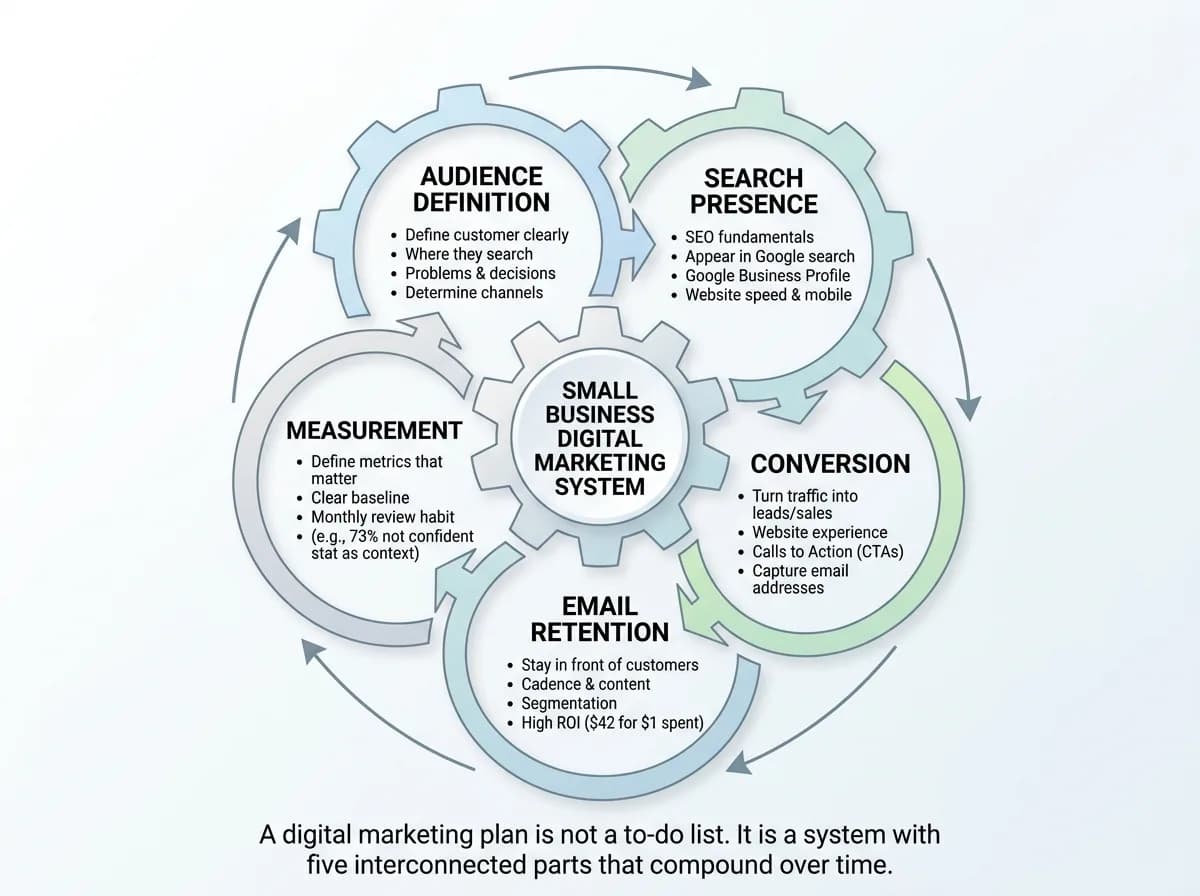
A digital marketing plan is not a social media calendar. It is a structured document that answers five questions for the business and creates a system for executing against them consistently.
1. Who are we trying to reach? Defining the customer clearly, including where they search, what problems they have, and how they make decisions, determines which channels are worth investing in and which are noise for your specific business.
2. Where do we show up when they search? This covers SEO fundamentals: whether the business appears in Google search results for the terms its customers actually use, whether Google Business Profile is optimized and up to date, and whether the website loads fast and works on mobile.
3. How do we convert visitors into leads? Traffic that does not turn into a contact or a sale is wasted. A plan covers the website experience, calls to action, and whether there is a mechanism to capture email addresses for follow-up.
4. How do we stay in front of customers and prospects? Email marketing delivers $42 for every $1 spent, the highest ROI of any digital channel, and 64% of small businesses already use it. A plan defines the cadence, content, and segmentation needed to make that channel actually work.
5. How do we measure what is working? 73% of small businesses are not confident their marketing is working. The reason is usually that they have no clear baseline and no consistent measurement. A plan defines the two or three metrics that actually matter for the business and creates a monthly review habit.
Why AI Changes the Economics for Small Businesses
The biggest shift in small business marketing over the past two years is not a new social platform or a new ad format. It is AI reducing the cost and time required to execute across every channel simultaneously.
75% of marketing professionals have adopted AI tools in their daily workflow in 2026. AI-driven campaigns are delivering 22% higher ROI with 32% more conversions on average compared to non-AI approaches. 85% of marketing tasks can now be automated through AI, including content creation, email copy, lead scoring, campaign personalization, and performance analysis.
For a small business without a dedicated marketing team, this matters enormously. Tasks that previously required hiring an agency, a copywriter, and an analyst can now be handled at a fraction of the cost with the right tools and a clear strategy driving them. The catch is that AI amplifies whatever system it is given. Without a plan, AI generates more undirected activity. With a plan, it generates more of what actually drives growth.
Why Kovazu
Kovazu is an AI and technology engineering agency. Digital marketing is not our core service, but everything underpinning modern digital marketing is exactly what we build.
We design and build the kind of website that actually performs: fast, mobile-optimized, structured correctly for search engines, and built to convert visitors rather than just look good. We integrate AI tools and automation into business workflows, including marketing workflows, so that small businesses can operate with the efficiency of a much larger team. We understand SEO and AEO (AI engine optimization) from the engineering side, not just the content side, which matters as AI-powered search becomes a larger share of how customers discover businesses.
We can also help with the foundational technology decisions that marketing depends on: CRM setup and integration, analytics configuration, email marketing infrastructure, and lead capture systems that feed into a single, measurable pipeline.
If you are a small business that needs a stronger digital presence and wants it built properly from the ground up rather than patched together, that is the kind of problem Kovazu is well suited to solve. We do not run your ads or post your social media, but we build the foundation that makes all of it work.
The Bottom Line
A digital marketing plan does not need to be complicated to be effective. It needs to answer who you are trying to reach, ensure you appear when they search, give them a reason to contact you, keep you in front of them afterward, and measure what is actually working. Small businesses that do this consistently outperform those spending more money without a system.
At Kovazu, we build the technology layer that makes marketing work: websites, integrations, automation, and AI systems designed to run efficiently and scale without proportional cost increases. If you want to build a stronger digital foundation, let's talk.
Written by
Emily CarterSenior Content Strategist & Market Trends Writer
Emily Carter writes about business, branding, SEO, and market trends with a focus on making complex topics easy to understand. She enjoys uncovering the strategies behind successful companies, emerging industries, and shifting consumer behavior. When she's not researching the latest market movements, Emily is exploring digital marketing trends, content strategy, and the evolving relationship between technology and business. Her goal is to create content that's insightful, practical, and worth bookmarking.