DRAM up 90%, cloud egress wrecking forecasts, GPUs idling on slow storage. Here is what enterprise storage trends actually cost in 2026.

How Enterprise Storage and Memory Trends Are Reshaping IT Costs in 2026
Enterprise storage and memory are no longer passive infrastructure. They are now active cost variables that directly affect AI performance, cloud bills, and hardware procurement timelines. If your IT budget was built on 2024 pricing assumptions, it is already wrong.
AI Is Driving a Memory Supercycle Nobody Budgeted For
The 2026 memory shortage is structural, not cyclical. Samsung, SK Hynix, and Micron, the three companies that control over 95% of global DRAM production, have systematically reallocated wafer capacity toward High Bandwidth Memory (HBM) for AI accelerators. Every HBM gigabyte sold to a datacenter displaces roughly four gigabytes of conventional DRAM that would otherwise reach enterprise and consumer markets.
The numbers are severe. Conventional DRAM contract prices rose 90–95% quarter-over-quarter in Q1 2026, with TrendForce projecting another 58–63% QoQ increase in Q2. NAND Flash contract prices are forecast to rise 70–75% in the same period. Enterprise SSD prices are up over 50% year-on-year. SK Hynix has stated its HBM, DRAM, and NAND capacity is sold out through 2026. Micron's CEO has guided for tightness continuing into 2027.
| Label | % price increase QoQ |
|---|---|
| Conventional DRAM Q1 | 92 |
| NAND Flash Q1 | 35 |
| Enterprise SSD Q1 | 55 |
| Conventional DRAM Q2 | 60 |
| NAND Flash Q2 | 72 |
The underlying cause is not a production accident. HBM commands margins three to five times higher than conventional DRAM, and hyperscalers are signing long-term agreements that lock in priority allocation. Smaller enterprise buyers without volume leverage are competing for residual supply at spot pricing that now changes faster than most procurement cycles. Memory quotes that used to be valid for 90 days are now often finalized at shipment. That is a new operating reality for any procurement team running quarterly budgets.
What this means for IT planning: Hardware refresh cycles that assumed flat or declining memory costs need to be rebuilt. DDR5 64GB RDIMMs, widely used in enterprise data centers, are forecast to cost roughly twice what they did in early 2025 by the end of 2026. Meaningful supply relief from new fabs is not expected before late 2027 at the earliest.
Cloud Storage Bills Are Becoming Impossible to Forecast
Most enterprises anchor their cloud storage budget on the per-GB headline rate. That is the wrong number. According to Wasabi's 2026 Cloud Storage Index, hidden fees including API calls, egress charges, and data operations now consume roughly half of total cloud storage bills. The headline storage cost is less than half of what you actually pay.
Egress fees are the single biggest culprit. AWS, Azure, and GCP all charge $0.08–$0.12 per GB for data leaving the cloud network, and those charges scale with every retrieval, analytics export, backup restore, cross-region replication, and AI dataset re-read. A team storing 100 TB and expecting a $2,300 monthly storage bill can easily receive $5,750 when egress, retrieval, and API fees are included, a 150% variance from the forecasted number.
AI workloads compound this problem specifically. Training pipelines reread the same datasets across multiple epochs, checkpoint restores move large files repeatedly, and inference outputs often cross regional boundaries. A single AI workload can generate 10–15 TB of monthly egress from a dataset that never grows. At AWS standard rates, that is $900–$1,350 in egress alone, often more than the storage itself costs.
The architecture fix is to co-locate storage and compute within the same cloud region and provider wherever possible. For workloads that inherently cross cloud or regional boundaries, evaluating providers with flat-rate or zero-egress models (OCI offers 10 TB/month free egress, for instance) can cut effective storage costs by 50% or more on transfer-heavy workloads.
Slow Storage Wastes GPU Time, and GPUs Are Expensive
AI training and inference are I/O-intensive in ways that most traditional storage infrastructure was never designed to handle. An LLM checkpoint during training can be several gigabytes written continuously under load. If the storage system cannot keep pace, training pauses, and every pause is GPU idle time billed at $2–$5 per GPU-hour.
The standard threshold in MLPerf benchmarks requires 90% sustained GPU utilization during training runs. Achieving that consistently demands storage capable of delivering 3–7 GB/s sequential throughput with sub-millisecond latency. NVMe SSDs over PCIe Gen4 deliver sequential reads up to 7,000–7,400 MB/s, while SATA SSDs top out around 550 MB/s, a 10–13x gap. At training cluster scale, that gap translates directly to runtime and cost.
NVMe-oF (NVMe over Fabrics) extends NVMe's low latency across a network, achieving 20–30 microsecond fabric latency rather than the tens-of-milliseconds typical of object storage. For shared AI infrastructure where multiple training jobs run concurrently, NVMe-oF over RDMA allows distributed GPU clusters to access shared storage pools without the metadata bottlenecks of legacy SAN or NAS architectures.
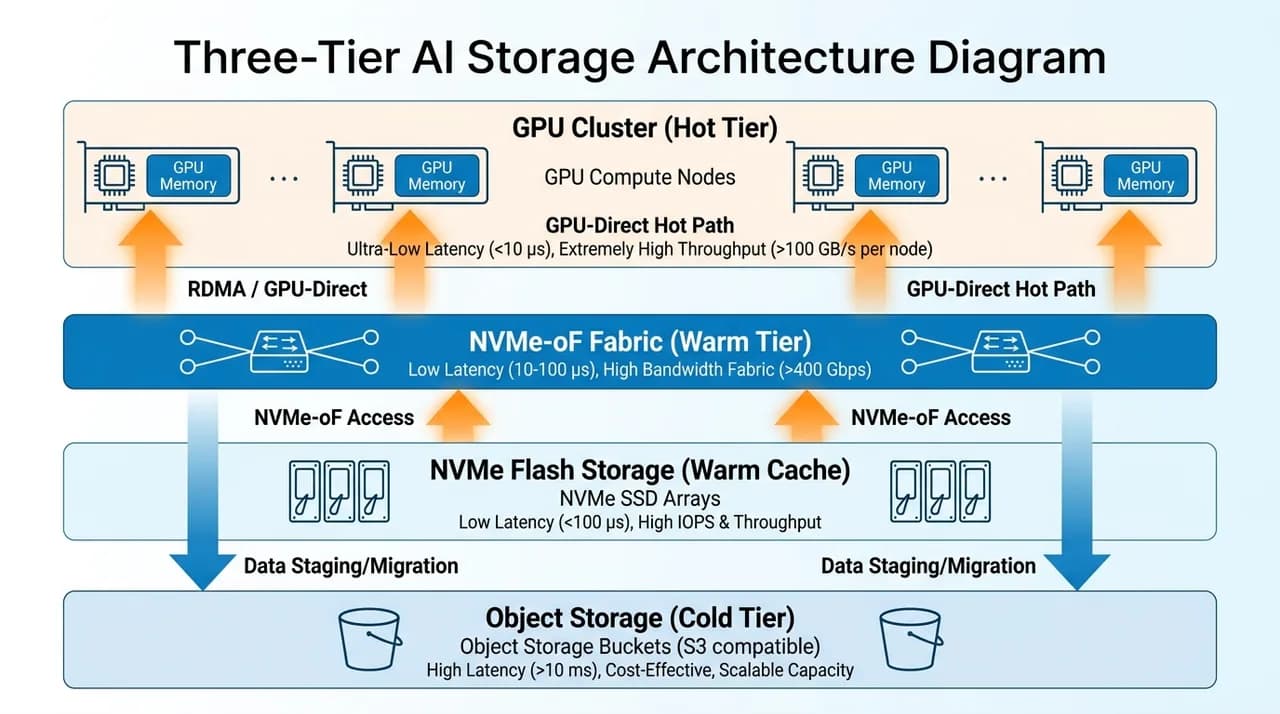
The practical decision framework for 2026: use NVMe (local or NVMe-oF attached) for active training data, working checkpoints, and embedding indexes. Use SATA-class SSDs for warm tiers covering prefetch caches, shard stores, and older checkpoint layers. Reserve cold object storage for raw archives, full dataset copies, and long-term compliance retention.
Capacity Planning Has Become as Important as Speed
AI models require significantly more data retention than traditional enterprise workloads. A single LLM training run at scale can produce terabytes of checkpoints, logs, intermediate outputs, and validation datasets. Fine-tuning pipelines layer on top of that. Inference at production scale generates its own data exhaust. The result is that organizations running AI in production are dealing with storage growth rates they have not encountered since early cloud migration cycles.
Tiered storage strategy is no longer optional. It is the primary tool for managing this growth economically. The principle is straightforward: keep only what needs to be fast, actually fast, and move everything else down the cost curve.
A workable enterprise tier model:
- Hot tier (NVMe, local or NVMe-oF): Active training datasets, inference model weights, embedding tables, and RAG vector indexes. Latency-sensitive. Sized to the working set, not total data.
- Warm tier (object storage, same region): Recent checkpoints, validation outputs, and datasets queued for upcoming runs. Accessible in seconds, priced at $0.02–$0.023/GB/month on standard tiers.
- Cold tier (archive): Completed experiment artifacts, raw input data, compliance backups. AWS Glacier Deep Archive and Azure Archive at ~$0.001/GB/month. Minimum retrieval times of hours, so plan ahead.
The sizing trap to avoid: object storage tier transitions and retrieval fees often negate the savings if cold data is accessed unexpectedly. A well-designed lifecycle policy that automates tiering based on last-access timestamps, combined with clear documentation of what is where, protects against the retrieval bill surprise.
Storage Optimization Is Becoming a Competitive Advantage
The teams that treat storage as a strategic variable rather than a fixed cost are discovering meaningful efficiency gains. AI-powered caching, automated tiering, and predictive failure detection are moving from vendor differentiators to operational baseline requirements in any serious AI infrastructure deployment.
Three specific patterns are generating measurable ROI in 2026:
Compute-adjacent storage. Placing storage nodes in the same rack or same network segment as GPU clusters eliminates the latency and egress costs of remote storage access. This is the engineering logic behind Xiaomi's GCache design for AI inference: SSD caches co-located directly inside GPU machines, adding zero storage overhead, and reducing inference costs enough to enable a 99% API price cut. The principle scales down to enterprise: every hop data travels costs latency and sometimes money.
Working-set-aware caching. AI workloads tend to reuse the same data in predictable patterns: the same system prompts, the same training shards, the same document corpora. Caching the hot subset aggressively (DeepSeek V4 Flash drops cached input cost from $0.14 to $0.003 per million tokens automatically) demonstrates the same principle applied at the API layer. At the infrastructure layer, keeping the active minibatch on NVMe and prefetching the next batch in parallel eliminates training stalls without requiring a larger hot tier.
IOPS-per-dollar as a procurement KPI. Rather than buying the fastest storage across the board, leading teams are benchmarking their actual workload I/O profiles against storage options and buying to the real requirement. A team that needs 200 GB/s sustained throughput for training checkpoints does not need NVMe Gen5 for its cold archive tier. Right-sizing per tier, then measuring GPU utilization improvement against storage cost, converts storage from an opaque infrastructure cost into a trackable efficiency metric.
The Bottom Line
Storage and memory are no longer background infrastructure decisions made once per budget cycle. In 2026, they are active cost levers that determine AI training efficiency, cloud bill predictability, and hardware procurement lead times. DRAM prices will remain elevated through at least 2027. Egress fees will keep blindsiding teams that do not measure them. And GPU utilization will keep suffering until storage architecture is treated with the same rigor applied to compute.
At Kovazu, we design AI infrastructure with cost efficiency built into the architecture, from storage tiering to model routing to inference caching. If you are building AI systems and finding that your infrastructure costs do not match your expectations, let's talk.
Written by
Emily CarterSenior Content Strategist & Market Trends Writer
Emily Carter writes about business, branding, SEO, and market trends with a focus on making complex topics easy to understand. She enjoys uncovering the strategies behind successful companies, emerging industries, and shifting consumer behavior. When she's not researching the latest market movements, Emily is exploring digital marketing trends, content strategy, and the evolving relationship between technology and business. Her goal is to create content that's insightful, practical, and worth bookmarking.
Keep reading
 Technology
Inside the AI Revolution Powering the 2026 FIFA World Cup
The 2026 FIFA World Cup is the first tournament built around AI from the ground up. Explore smart match balls, AI officiating, digital twins, real-time analytics, and connected stadiums transforming football forever.
 Technology
GTA 6 Launch: What It Means for Gaming, Technology, and Business
GTA 6 is more than a game launch. Its record-breaking scale, billion-dollar projections, and engineering ambition offer lessons for tech companies, product teams, and digital businesses.
 Reviews & Comparisons
Mailchimp vs Kit: Which Email Marketing Platform Is Worth It in 2026?
Mailchimp and Kit (formerly ConvertKit) serve different audiences. Compare pricing, automation, integrations, APIs, and features to find the right email marketing platform for your business in 2026.