Android 17 and Gemma 4 bring powerful on-device AI to phones and laptops. Learn how offline AI, NPUs, privacy, and local inference are changing app development and user experiences.

Android and Laptops Get Built-In Local AI: What Android 17 and Gemma 4 Actually Change
Android 17 and Google's new Gemma 4 model mark the point where on-device AI stops being a lab experiment and becomes a real, shipping feature on phones and laptops. Google released Gemma 4 on April 2, 2026, and folded it directly into Android 17, which began rolling out to Pixel devices in June. For the first time, a genuinely capable AI model runs entirely on your phone or a mid-range laptop, with no cloud connection required and no data leaving the device.
What Actually Shipped
Android 17 bundles Gemma 4 12B, a local multimodal AI model built to run on laptops with as little as 16GB of RAM and no discrete GPU. It handles text, image, and audio input in a single prompt, generates streaming text and structured output like JSON, and can call external APIs to act as an agent that controls a browser, a file system, or a smart home device. Google says the model is up to four times faster than its predecessor and uses roughly 60% less battery, closing the gap that used to make on-device processing feel slower and more draining than simply asking the cloud.
Gemma 4 actually ships as a small family of models rather than one fixed size, and the size you get depends on the device. Gemma 4 E2B needs about 8GB of RAM and 2GB of storage, tuned for maximum speed on phones. Gemma 4 E4B needs 12GB of RAM and 4GB of storage and trades some speed for stronger reasoning. A larger 26B MoE variant, aimed at developer workstations rather than phones, is powerful enough to work as a full local coding agent, refactoring code and fixing build errors without ever sending a single line to a cloud API.
What This Means in Practice
The headline feature list reads like ordinary phone conveniences, but the mechanism underneath is new. Smarter autofill, on-device summarization of a lecture photo or a long email thread, and Chrome's built-in content summarization now run locally rather than sending your text to a server first. Android 17 also adds AI-powered shortcuts that carry out multistep tasks from a single natural-language instruction, automating things like bookings or routine shopping tasks directly on the device.
The privacy angle is not marketing language here. When a model runs entirely on-device, the actual content of what you are asking, a photo of a whiteboard, a private note, a voice memo, never has to leave the phone to get an answer. That matters more the more sensitive the task is, and it removes network latency from the equation entirely: a request that used to take several seconds round-tripping to a server can resolve in a fraction of that time locally.

The Hardware Question: Is Your Phone Actually Ready?
This is where the story gets more interesting than the official announcement lets on. Independent testing throughout 2026 has shown that flagship Android phones already had the hardware to run real local language models well before Google's own on-device assistant caught up to using it properly.
The OnePlus 13, built around a Snapdragon 8 Elite chipset with an NPU rated around 80 TOPS (trillion operations per second) and 12 to 16GB of RAM, has become one of the most-cited devices in independent local LLM benchmarking throughout 2026. Testing comparing local inference apps across the Galaxy S25 Ultra, Pixel 9 Pro, and OnePlus 13 found that apps built to actually use the Snapdragon Hexagon NPU directly, rather than falling back to the CPU, reached roughly 40 tokens per second running a small Qwen3 1.7B model, compared to just 8 to 12 tokens per second on CPU-only apps running the identical model on the same hardware. That is a four to five times speed difference based entirely on whether the software is written to use the dedicated AI silicon that has been sitting in these phones for over a year.
That gap is exactly why Gemma 4 matters more than a typical model release. It is one of the first mainstream models built specifically to take advantage of the NPU hardware that phone makers have been shipping ahead of software that could actually use it well.
Why Google Waited This Long
It is worth asking why this did not happen sooner, since the NPU hardware in flagship phones has been capable of small-model inference for well over a year. Commentary from hardware reviewers throughout 2025 made the same point repeatedly: manufacturers had the silicon, but the models available were not yet good enough to match the quality of a cloud-hosted assistant, so most phone AI features quietly ran on a cloud model behind the scenes regardless of what the marketing implied.
Gemma 4 is Google's answer to that gap closing. The model family is explicitly designed to make local-first agentic AI viable across the entire software lifecycle, from a coding assistant that runs entirely on a developer's own machine to a lightweight assistant embedded directly in the phone's operating system. Gemma 4 is also described as the foundation for the next generation of Gemini Nano, the system that actually powers Android's built-in AI features, meaning what ships in Android 17 today is an early look at a local AI stack that Google intends to keep building on.

What This Signals for the Next Few Years
The direction here is clear even if the rollout is gradual. AI processing is moving from something that happens in a distant data center to something that happens on the device already in your pocket or on your desk, and the three constraints that used to make that impractical, model quality, battery drain, and NPU utilization, are all improving simultaneously rather than one at a time.
This does not mean cloud AI disappears. The largest, most capable models still require data-center-scale compute that no phone will run locally any time soon, and Fable-class or GPT-class flagship models are not coming to a phone NPU in the near future. What is changing is the split: a growing share of everyday AI tasks, summarizing a message, autofilling a form, transcribing a note, running a quick coding fix, no longer need to leave the device at all. That shift is good for latency, good for battery life, and good for privacy, and it changes what businesses building AI-powered products should think about when they design a feature: not everything needs a round trip to an API anymore.
How Kovazu Thinks About This
At Kovazu, we build AI-powered products, and the local-versus-cloud decision is now a real architecture choice rather than a foregone conclusion. Some features genuinely need frontier-model reasoning and belong in the cloud. Others, quick classification, summarization, simple agent actions, structured data extraction, can now run locally on modern hardware, cutting latency and API cost at the same time. Knowing which is which, and building a product that uses both intelligently, is exactly the kind of system design we help businesses get right.
If you are building a product and want to think through where local AI fits into your architecture, let's talk at Kovazu.
The Bottom Line
Android 17 and Gemma 4 mark a real inflection point, not just an incremental model release. The hardware needed for capable local AI has existed in flagship phones for over a year, and Gemma 4 is the first mainstream model built specifically to use it well, four times faster and using 60% less battery than what came before it, while independent NPU-optimized apps are already squeezing four to five times more tokens per second out of the same silicon that ships in phones like the OnePlus 13. The practical result for anyone using an Android phone or a mid-range laptop over the next year: more AI features that work instantly, work offline, and never send your data anywhere at all.
Written by
Ritvik NairAI Developer & Technology Writer
Ritvik Nair is passionate about artificial intelligence, automation, software development, and the technologies shaping the future. He enjoys exploring new AI models, developer tools, and emerging innovations, turning complex technical concepts into content that's clear, practical, and engaging. Whether he's writing about large language models, productivity tools, or the latest breakthroughs in tech, Ritvik focuses on helping readers understand not just how technology works, but how it can be applied in the real world. He believes great tech content should be insightful, accessible, and genuinely useful.
Keep reading
 Artificial Intelligence
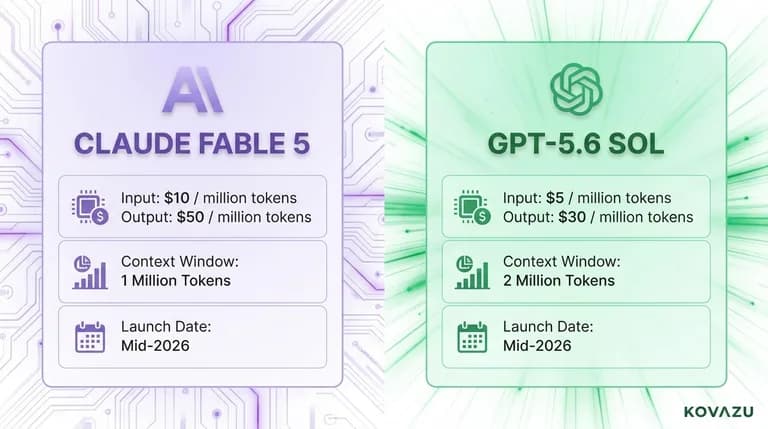
Fable 5 vs GPT-5.6: Which AI Model Should You Choose in 2026?
Claude Fable 5 and GPT-5.6 Sol are the most advanced AI models of 2026. Compare benchmarks, pricing, context windows, safety, and real-world use cases to determine which model best fits your business and development needs.
 Artificial Intelligence
Fable 5 Is Back: What Anthropic’s Biggest AI Model Return Means for Users
Claude Fable 5 has returned after a 19-day suspension, bringing top-tier coding performance, new safety controls, a limited access window, and premium pricing. Here's what developers and businesses need to know before adopting it.
 Artificial Intelligence
The Inference Cost War: Token Pricing Is the New AI Moat
Inference pricing spread 100× in 2026. Here's what every major model actually costs and how to route smarter.