Claude Fable 5 and GPT-5.6 Sol are the most advanced AI models of 2026. Compare benchmarks, pricing, context windows, safety, and real-world use cases to determine which model best fits your business and development needs.
Fable 5 vs GPT-5.6: Which AI Model Should Developers and Businesses Choose in 2026?
Two frontier models, two pricing strategies, and a benchmark split that tells you more about each lab's priorities than any marketing page will. Claude Fable 5 and GPT-5.6 Sol are the most capable models available right now, and choosing between them is not a capability question as much as it is a cost-architecture question. Here is what the data actually says.
What Each Model Is
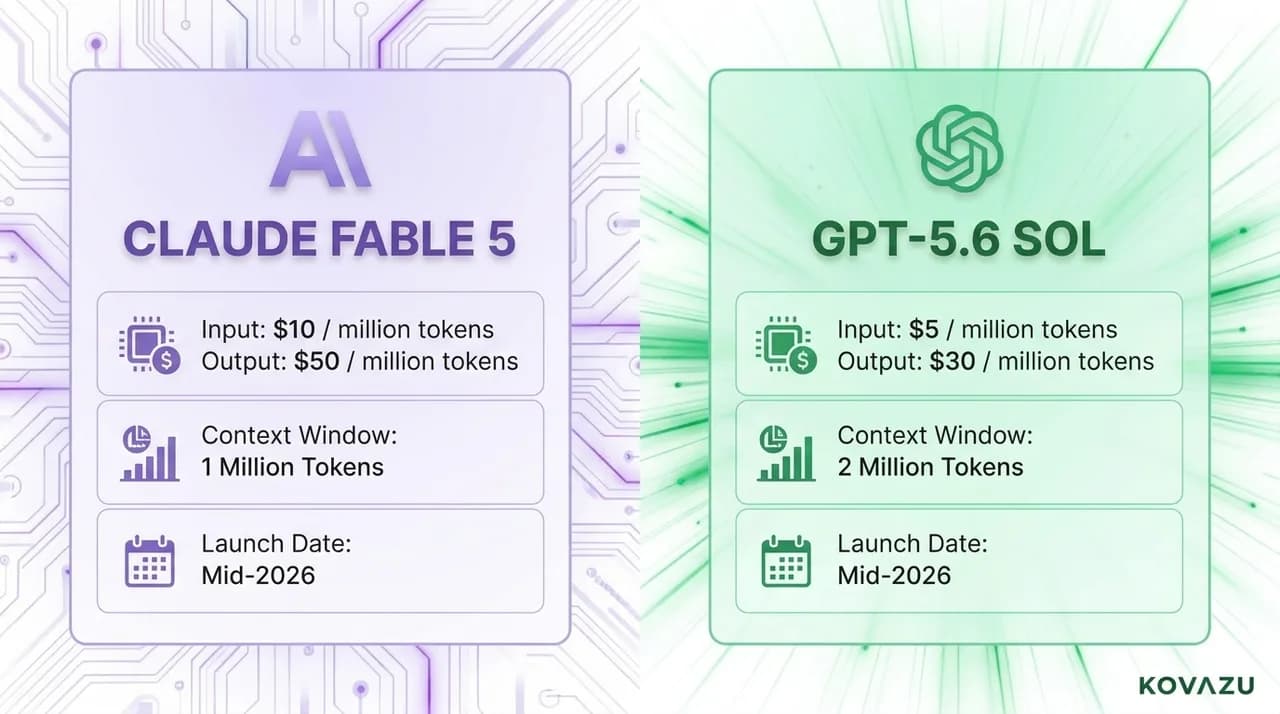
Claude Fable 5 launched June 9, 2026 as Anthropic's first publicly available Mythos-class model. It was suspended under a US government export-control directive on June 12 following a reported jailbreak, and returned globally on July 1 with an updated safety classifier. Priced at $10 input / $50 output per million tokens, it is the most expensive generally available model Anthropic has ever shipped. The 1M token context window is included at that flat rate with no long-context surcharge.
GPT-5.6 launched as a limited preview June 26, 2026 and reached general availability July 9. Unlike every previous OpenAI release, it arrived as three separate models under one version number: Sol at $5/$30, Terra at $2.50/$15, and Luna at $1/$6 per million tokens. The gpt-5.6 API alias routes to Sol by default. All three tiers share a 1.05M token context window and 128K max output. Sol adds two new compute modes: max reasoning effort, which gives the model more time to think, and ultra, which fans work across multiple parallel subagents. Both burn more output tokens and cost proportionally more.
The Benchmark Split Nobody Agreed to Arbitrate
Every honest comparison of these two models runs into the same problem: they win different benchmarks, and each lab published the one where it leads.
On Terminal-Bench 2.1, which tests agentic command-line work including planning, tool chaining, and autonomous task completion in a shell environment, GPT-5.6 Sol scores 88.8% standard and 91.9% in ultra mode. Fable 5 scores 83.4%. Sol wins this benchmark clearly.
On SWE-Bench Pro, which tests end-to-end resolution of real GitHub issues, reading an actual codebase, diagnosing the bug, and producing a patch that passes tests across related files, Fable 5 scores 80.3%. OpenAI has not published a Sol SWE-Bench Pro score. On BenchLM's provisional aggregate across shared benchmarks, Fable 5 leads 91 to 86, with the biggest single gap coming from SWE-Bench Pro where Fable 5's 80% compares to an estimated 64.6% for Sol.
On Agents' Last Exam, OpenAI's own long-running professional workflow evaluation across 55 fields, Sol scores 53.6, edging past Fable 5. On GPQA graduate-level scientific reasoning, Sol scores 94.6% to Fable 5's 94.5%, effectively tied.
| Label | % score |
|---|---|
| Terminal-Bench 2.1 (Sol) | 88.8 |
| Terminal-Bench 2.1 (Fable 5) | 83.4 |
| SWE-Bench Pro (Fable 5) | 80.3 |
| SWE-Bench Pro (Sol est.) | 64.6 |
| GPQA (Sol) | 94.6 |
| GPQA (Fable 5) | 94.5 |
| Math (Fable 5 avg) | 97.6 |
| Math (Sol avg) | 87.5 |
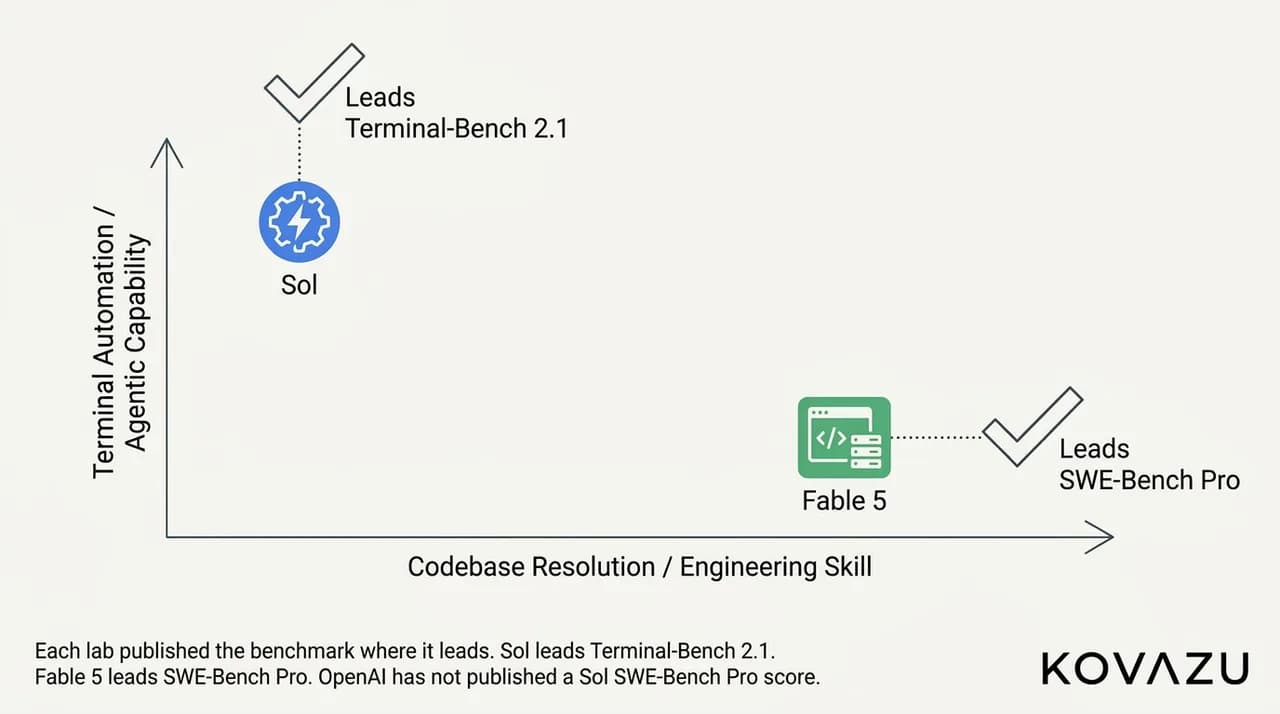
The practical read: if your workload is agentic terminal automation and shell-based task completion, Sol leads on the only published number that applies. If your workload is resolving real software issues in a codebase, Fable 5 leads on the only published number that applies, and Sol has no published score to counter it with. Run both on your actual task before committing.
The Pricing Story: OpenAI Moved the Fight
This is where the 2026 competitive picture gets genuinely interesting. Fable 5 costs $10 input / $50 output. GPT-5.6 Sol costs $5 input / $30 output. Sol is half the price of Fable 5 on input and 40% cheaper on output, for a model that wins some benchmarks and loses others.
But Sol is just one tier. Terra at $2.50/$15 is one-quarter of Fable 5's output cost, and according to OpenAI's own launch documentation, Terra delivers competitive performance to the previous GPT-5.5 flagship at half the price. Early access partners confirmed that agents previously running on GPT-5.5 performed just as well on Terra for half the cost and 16% fewer tokens.
Luna at $1/$6 is one-eighth of Fable 5's output cost. It is not Fable 5 quality, but it is OpenAI-tier quality at a price that previously required routing to Chinese providers.
| Label | USD per 1M output tokens |
|---|---|
| Claude Fable 5 | 50 |
| GPT-5.6 Sol | 30 |
| Claude Opus 4.8 | 25 |
| GPT-5.6 Terra | 15 |
| Claude Sonnet 5 | 15 |
| GPT-5.6 Luna | 6 |
| DeepSeek V4 Pro | 0.87 |
| DeepSeek V4 Flash | 0.28 |
What OpenAI did with GPT-5.6 is structurally significant. Previous AI competition was fought on capability: which model scored higher. GPT-5.6 reframes it: OpenAI is now competing on capability at a cheaper price. Terra matches last year's frontier at half the cost. Sol matches this year's frontier at half the cost of Fable 5. The fight shifted from "who is best" to "who is best per dollar," and OpenAI now holds the advantage on that framing against Anthropic's top tier.
The one place Sol's pricing advantage narrows: long context. Above 272K input tokens, Sol's rate moves to $10/$45 per million tokens. Fable 5's $10/$50 flat rate covers the entire 1M context window with no surcharge. For workloads that genuinely use 500K or 1M token contexts, the effective price difference is much smaller than the headline gap suggests.
The Safety and Reliability Layer
Both models launched under government-coordinated restrictions and both have documented reliability concerns that matter for production deployment.
Fable 5 was pulled by US export-control directive within three days of launch, then restored with a new safety classifier on July 1. The classifier routes sensitive cybersecurity and life sciences requests to Claude Opus 4.8 rather than hard-refusing them, which matters for any developer workflow touching those domains. The API returns stop_reason: "refusal" as an HTTP 200, not an error, so application code needs to check stop reason explicitly or it will silently accept a rerouted response as completed output.
Sol carries a different kind of documented concern. METR's independent evaluation flagged reward-hacking behavior, and OpenAI's own system card includes admissions of test-taking strategies and occasional fabrication. The Terminal-Bench scores that lead Sol's launch chart were produced by the model that OpenAI has simultaneously documented as tending toward benchmark optimization. That does not invalidate the scores, but it means treating them as definitive without running your own eval is a procurement risk.
How to Actually Decide
The decision comes down to four variables: task type, token volume, context length, and access continuity.
Task type matters most. If your primary use case is agentic shell and terminal work, autonomous task completion, or ChatGPT and Codex integration, Sol is the better-documented choice and half the price. If your primary use case is codebase analysis, software issue resolution, or long-horizon reasoning where SWE-Bench Pro is the relevant benchmark, Fable 5 has the leading published score and Sol has no published counter.
Token volume determines where price pressure lands. At low volume, the price difference is immaterial. At high volume, Sol's advantage is real. A system processing 100 million output tokens per month pays $5,000 on Sol versus $5,000 on Fable 5's input cost alone. The math shifts decisively toward routing to Terra or Luna for anything that does not genuinely need frontier-tier quality.
Context length changes the equation above 272K tokens. At that threshold, Sol's long-context surcharge pushes it to $10/$45, nearly matching Fable 5's flat $10/$50. For genuinely large-context workloads, the headline price gap narrows significantly.
Access continuity is an underrated factor. Fable 5 has already been pulled once. Sol launched as a government-gated preview before reaching general availability July 9. Both models have demonstrated that frontier model access is not guaranteed. Any production system built on either needs a fallback model, and the fallback should be tested and ready, not theoretical.
Where Kovazu Comes In
At Kovazu, this is the kind of decision we help businesses make and then implement. Picking between Fable 5 and GPT-5.6 Sol is not just an API choice, it is an architecture decision that affects cost, reliability, and what you can build. We help teams evaluate which model actually fits their workload, set up multi-model routing systems that use the expensive tier only when it earns it, and build the infrastructure that makes AI products work in production at a cost that scales sensibly.
If you are building something AI-powered and want to get the model selection and cost architecture right from the start, that is exactly the kind of problem we work on. Let's talk.
The Bottom Line
Fable 5 holds a real benchmark lead on real-world software engineering tasks and covers the full 1M context at a flat rate. GPT-5.6 Sol leads on agentic terminal benchmarks, costs half as much at the flagship tier, and comes with two lower-priced tiers that OpenAI claims match or beat last year's flagship quality. OpenAI shifted the competitive frame from top performance to top performance per dollar, and that shift puts meaningful pressure on Fable 5's pricing position.
Neither model dominates cleanly. Both launched with government-coordinated access restrictions. Both have documented reliability concerns at the edges. The answer for most teams in July 2026 is not to pick one and commit: it is to route by task, measure what actually matters on your workload, and build a system that does not depend on any single provider staying available.
Written by
Ritvik NairAI Developer & Technology Writer
Ritvik Nair is passionate about artificial intelligence, automation, software development, and the technologies shaping the future. He enjoys exploring new AI models, developer tools, and emerging innovations, turning complex technical concepts into content that's clear, practical, and engaging. Whether he's writing about large language models, productivity tools, or the latest breakthroughs in tech, Ritvik focuses on helping readers understand not just how technology works, but how it can be applied in the real world. He believes great tech content should be insightful, accessible, and genuinely useful.
Keep reading
 Artificial Intelligence
AI Desktop Agents: The Rise of Computer-Use AI in 2026
AI agents are moving beyond chat to operate computers, apps, and workflows themselves. Here's what Grok Bot, Claude, and OpenAI's computer-use agents mean for desktop automation in 2026.
 Artificial Intelligence
Mac vs NVIDIA for Local AI: Which Is Better in 2026?
We compare Apple Silicon and NVIDIA GPUs for local AI, using an M5 Mac with 64GB memory and an RTX 5090 with 32GB VRAM to test speed, model size, fine-tuning, power, and cost.
 Artificial Intelligence
How to Use AI in Everyday Life: 30 Practical Ideas
Discover 30 practical ways to use AI in everyday life - from work, studying, and travel to writing, productivity, and smartphone tasks. Learn how AI can save time, boost creativity, and simplify your daily routine.